Thursday, March 4, 2021

Salesforce Service Cloud Performance/Delighter Features

True to the core principle of Kano framework, salesforce product has evolved over the period to meet the basic needs, performance features and delighters for customers. Once delighters turn into basic needs, something new and interesting comes up again to keep the arena exciting. With increasing product portfolio with both organic and inorganic growth Salesforce seem to have identified the trick to select feature that can greatly enhance user experience. As per recent releases salesforce came up with few productivity features related to Service cloud to delight the users and customers alike. Some of it listed below that can help to cut down the customization and make application/product feature rich with little effort (read low code / no code).

  1. Identifying Knowledge article relevant to the case to give faster case resolution – In many of the engagement you may have used once a delighter feature of knowledge sidebar which gave a quick option to agent to select suggested article (unordered set) or search for knowledge article and attach it to case or email response to take forward the case for closure.  Any requirement around auto association of article based on certain set criteria ended up getting into customization route. And then came then Einstein knowledge article recommendation that gives an AI based model which continuously gets trained with each agent actions on article attachment or downvoting. Advantage it gives over standard suggested article is that outcome of recommendation is an ordered set with highest match on top of recommendation bar and will potentially saves the costly real-estate.
  2. Recommending probable picklist field value for case classification – Each second saved in resolving a case in service/call center industry counts a lot as each of those seconds by giving agents prefilled suggestion translates into millions of seconds for millions of cases addressed by the agents over a period. One such mundane and repetitive task is to fill some of the key fields on case which are useful for reporting purpose. Case Type, Sub-type, Reason, Resolution Type etc. which quite a few times left blank and hits on data quality. Only caveat to use this feature is a significant count of closed cases with relevant fields filled in (~4000) to train the model. But at same time model will get trained and start functioning with organic growth in data.
  3. Identifying likelihood of case escalation or reopening – Nothing beats the customer experience and enhanced loyalty than timely response to cases without a need to follow-up. Knowing in advance which customer can potentially reopen cases or identifying in advance the complex cases which potentially escalate in future help in routing the cases to expert agent to give attention case deserves as well win the customer loyalty. In service cloud context, prediction builder comes handy which again gets trained organically but having a cleaned data set to train it greatly improve the outcome.
  4. Einstein Reply Recommendation – Once a delighter feature called quick text for chat, email, etc. are slowly becoming a basic requirement. To up the game further salesforce has come up with reply recommendation primarily for chats. This gives an option to agent via side bar on possible response that can go for upcoming message from customer. To enhance the experience further sidebar gives opportunity to agent to edit the message before posting it. Unlike other features, here there is a mandate to have minimum number of chats replies available in system. It makes sense to include this once ample number of entries are available in the org and bring it in delta release to continuously wow the agents/customers.

While all these features greatly improve the experience it majorly feed on data. And, major issue with all data led models is – the models are as good as the input/training data. It always helps to have cleaned data to train the system and utilize the feature to full. If that is not the option, keeping those fields as mandatory and monitoring the data correctness in initial stage will serve as a good investment.

All these features typically come­­­­ along with Unlimited/Enterprise edition having Einstein service cloud feature license enabled. Bundled licenses typically comes at heavy discounts and certainly a good investment.

Details for implementing these features and associated prerequisite are available in reference links.

References –

Tuesday, February 23, 2021

Retirement Planning - How much is enough?

Disclaimer - Neither I am a financial advisor nor recommending any financial solution. This is plain layman view.

I am back again with a very random post with no linkage to what I do in professional life but certainly one area which always keep me excited. Finance/number crunching it is.

Of late one though kept me bothering how much is enough for future. While philosophical answer will suggest there is no end to what you can call as enough but thinking practically you can probably realize that what you are comfortable with right now will hold good even in future taking everything else as constant. You can certainly think about improving the stature but that is an uphill task where the hill keep on getting changed once you ace it.

Coming back to finance world - corporate finance 101 focus primarily on time value of money. What can be bought with X amount of money might be out of reach with same X amount of money in Y number of years. If this X,Y is troubling just recall the common phrase from your parents/grand parents - hamare jamane mein itne paise mein itni cheeze aa jaati thi (in our time, for this amount I was able to buy so many things). For example - a single lollypop some 10 year back costed may be 0.5 rupee but now probably cost around 2.5 rupee. To put it in simple words, money keeps on loosing value with each passing year and inflation is one to be blamed for that. Historical trend suggests an average 6% (Year-on-year) rate for inflation. 

To answer question how much is enough is a tricky task as this number will differ from person to person. For someone like Super cop Singham for whom 6000 Rs/month is enough because his zameer has dum as his necessities are kam (mere zameer mein hain dum kyunki meri zarurate kam) and may be for our great Ambani jee even 6000 lakh Rs/month may not be enough (not because his zameer doesn't have dum but because his necessities and daily expenses are huge to maintain his current life style). 

Simple excel calculation can tell you for 6% inflation 1 Rs today will be equivalent to 3.82 Rs at time of retirement age of 58 years, that is after 23 considering your current age of 35 years. That will also mean that you will get to live 24 more year post retirement and the value of 1 Rs will balloon to 15.47 Rs (47 years from now). Considering around 20% margin (I invented this number) over average current life expectancy of 69.93 years in 2021 in India . Why more you ask? Because if you were able to read this far and also intelligent enough to search and plan for retirement then you are above average and that would mean that you will get to live more (unfortunately from financial planning perspective). Moreover, when it comes to averages some number have to be above the average to make up for those numbers which are below average. 

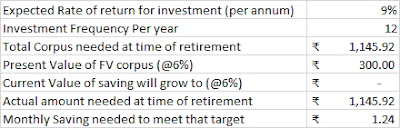
Now comes the question how much is enough. If you are a minimalist of age 35 years and able to make ends meet with 20,000/month then multiply 20000 with the column 'Total Corpus needed at time of retirement' to get ideal retirement corpus at time of retirement or 20,000 to 'Present Value of FV corpus (@6%)' to reach amount that you need now (at present time) to stop worrying about retirement corpus completely. Rough calculation suggests that 2.3 Cr s what you require at time of retirement for someone with monthly expense of 20K after 23 years from now. Now doing a reverse engineering with that number will suggest how much you need to save per months to reach that number (roughly 25K/month assuming you have no savings as of now for minimalist person). I am ignoring all other future surprises and commitments like family/child's, your future health expenses, etc for which you should be maintaining separate corpus. If this sounds daunting then you got to relook at your finances and identify ways to either fix your finances or your expenses/lifestyle or probably both. 

Here goes the calculation which I did for person aged 35 years with monthly expense of 1 Rs/month having 23 years of professional career ahead and probable life of 24 years post retirement. I am also taking liberty to assume growth on future investment as 9% per annum and inflation rate aligned with historical inflation rate of 6% per annum. Choosing a expense number as 1 Rs so that you can multiply it with current expenses  to reach your corpus amount. As I have already considered your current saving growth at 6% inflation target you can forget about that part. If you hope to live beyond 82 then too bad! You may have to plan for additional earing avenue or probably cut your expenses. And, luckily if you live lesser then think of this as leaving a legacy for your next generation to act as a seed capital for their startup which you always thought about but never dared to open. After all in my opinion, there is a very thin line between being coward and practical.


What the lower part of calculation suggests is if you have mentioned amount as your current saving in "present value of FV corpus" then you can live peacefully and work only to take care of other commitments. Also, assuming that your current saving will only beat the inflation of 6% and you aren't making any specific effort to grow your capital other than getting into govt/sovereign bond. And finally the calculation for monthly saving you need to meet the retirement corpus target. All can be multiplied with number which you expect to be at your disposal at time of retirement/month.

A very long post but made an attempt just to understand where do I stand. From Gyan perspective, this is what calculation tells us but in real-life there are N number of things can happen and you can't plan for that But planning never harms as it helps to identify the challenges and any future regrets that I wish if I had done this or that. Train will anyways hit you if you aren't able to take any action but at least you will be aware that train will hit you at some point in time and you will be at peace.

Note - I have primarily used FV and PV function in excel to calculate the future value and present value. Used PMT function to calculate the monthly investment needed to meet the retirement corpus goal. In order to keep the calculation I had to make several adjustments but not something difficult to update. Will share the public link of the excel with columns that can be updated to get the actual number. It may not really give the Y-O-Y view but consolidated numbers can certainly be seen.